Thursday, June 30, 2011

Cosmic Invariance

If the universe is truly cyclic in nature, does that mean its evolution is as well? In cyclic cosmologies, the universe expands from a singularity and evolves, mostly according to Newton's laws of motion (let's leave quantum effects out of the picture for now). From the starting singularity, there's a burst of energy and expansion. As particles expand outward, they come into contact with one another - they trade energies, repel, coalesce with new momentum and continue on their way. In this respect, the analogy of a game of pool is very apt. Think of the starting singularity as the initial break and the subsequent motions and interactions all under the control and guidance of Newtonian mechanics. If you knew the exact position and momentum of each and every particle, you could figure out where any one would be and what it would be doing a billion or one hundred billion years from now. In short, the universe is deterministic and clockwork for the most part. Furthermore, and more to the point of this post, the universe appears to be a closed system like a box of gas or a pool table with balls in motion on it.

Henri Poincaré. Note the spiffy glasses and awesome beard.
Why did I shave?
In the late nineteenth century, mathematician Henri Poincaré, as part of an attempt to solve the infamous "three body problem" (in short, how three objects would move under the influence of mutual gravitational pull) stumbled upon something he called the Recurrence Theorem. This was the heyday of statistical mechanics and Boltzmann's descriptions of entropic forces and the evolution of closed systems was in many ways the central focus of physics. What Poincaré discovered, put simply, was that if you started a closed system (one free of outside physical influence) in any particular configuration and let it evolve according to Newton's laws of dynamics (motion), and if you had an infinite amount of time to wait and observe, that system would eventually return to its initial configuration, not just once, but over and over again. The fewer the components you have the shorter the recurrence time would be and the more you add, the longer you'd have to wait. The universe is home to more particles than can possibly be imagined, so the recurrence time would be huge - but if the universe is really eternal (and closed), it is virtually guaranteed to return to its initial state and evolve precisely along the same lines all over again.

Think about what that means for a moment. Every single event in the history of your life, in the history of the universe, would be bound to repeat itself, over and over and over again - with no variation within those particular evolutions. How long would we have to wait for one recurrence time for the universe? A box with sixty particles in it has a recurrence time of the present age of the universe. In other words, it would take a box of sixty particles nearly 14.7 billion years to return to its initial configuration, statistically speaking of course. By comparison, a typical macroscopic object, made up of much, much more than sixty measly particles, has a recurrence time would be 101,000,000,000,000,000,000,000,000 seconds. (Carroll, 205-206).

The idea of recurrence seems much more profound than mere fate. A typical determinist may look at the universe and say, "Well, it's all in motion like a train and cannot be stopped." Life unfolds, the universe evolves and there's no tampering with it. It's almost like a movie playing itself out, but that analogy isn't quite right because it's as if we, the observers are part of the movie too. Our reactions to it, indeed, even whether we recognize it as such, has already been determined as part of the story. But if Poincaré is correct, and he is mathematically, if not physically, then it's a movie on repeat - a disc stuck in a dvd player, but you'd never recognize it as such. If a cyclic cosmology is correct and the universe indeed goes through expansion and contraction phases infinitely into the future with a sort of bounce in between, then certainly some, though probably not all, of the expansions may create histories that look exactly like our own, given we wait long enough. The life you experience now may be the very first of a series of repetitions you can do nothing about or control - or, it could be the 1,000,913,456th. It may happen all over again in the very next cycle the universe goes through, or it may take another ninety evolutions, but here you'd be all over again - with the same joys and frustrations, accomplishments and failures.

Even more interesting: in an endlessly cycling universe there are bound to be cycles where the history or evolution is dramatically different. Ones in which no sentient life forms exist or evolve at all, for example. Or, it could have evolutions that are quite similar, but subtly different (from a cosmic perspective at least). There could be alternate histories and evolutions where Hitler was never born (a favorite for alternative history science fiction fodder), or where you were born in another country, to another set of parents (but would it still be you?). All it would take is the subtle displacement of a single hydrogen atom or a change in vector of a single electron to change the whole subsequent history of the universe, giving birth to different realities and different histories each time the universe expands anew.
Could you be born into a family of Wookies because an electron
zigs instead of zags in the next expansion cycle of the
universe?

Is it true? Are we doomed (or blessed) to live the lives we have now forever? For truly any other evolution, no matter how slightly different, would result in an us that is not us and therefore different. This reality is all that we have. Well, there's a couple of snags that complicate Poincaré's picture:

1. What we know of quantum mechanics seems to suggest that there is an inherent level, not of randomness, but probability to reality itself. Virtual particles pop into and out of existence, leaving their mark, no matter how subtle in a myriad ways - causing black holes to evaporate or contributing to mysterious macroscopic behaviors like the Casimir Effect. In short, ephemeral instability and unpredictability have a subtle effect on macroscopic objects and their motion or movement. If such events truly are part of the fabric of reality, they would perpetually disturb the motion of electrons and other subatomic particles and alter the history of each subsequent expansion or history. Would it still be possible for the same evolution to occur, down to the same perturbations? Maybe. Probably, given that you had an infinite amount of time to sit around and wait, but the recurrence time would be even more monstrously huge.

2. On a more concrete level, we know that the universe is expanding. Leave aside whether or not the universe is indeed closed or open, or if we're one pocket universe nestled in a multiverse of other universes - cosmologists know that objects in the universe are moving away from one another. Not only that, but they're doing so at an accelerating rate. In short, that's bad news for cyclic cosmologies. When is contraction going to occur? By what means? It seems like expansion will continue into the future unchecked, stretching the particulate matter of the universe into a thin gruel spread over even more unimaginable distances. It's hard to imagine a spontaneous contraction that would reverse then start the cycle all over again. It seems far more likely that the universe will suffer entropic heat death and it'll all end in a Big Freeze.

3. Even more basically, cyclic cosmologies may be inherently incorrect, the reason stated in point #2 being just one flaw of such theories (see earlier posts).

4. Even among those who embrace cyclic cosmologies, like Roger Penrose, there are those (again, like Penrose) who believe that events in one expansion cycle effect events in the next. Penrose believes that events in the previous cycle have left imprints on the Cosmic Microwave Background that are visible today. Those imprints, speculated to be caused by supermassive black holes near the end of the contraction of a previous cycle, surely would affect the motion of particles in this expansionary phase. In short, there is no repetitive, or recurring cycle as events in one cycle have specific effects on the next.

Granted, I'm no expert, but I tend to think that while recurrence is a pretty thought-provoking and amazing idea to think about, it has no strong scientific backing. Poincaré's math is solid. If you really did have a closed system and we only considered Newtonian physics, recurrence would occur. Unfortunately (or fortunately), I don't think the universe is quite as neat or simple as a box of gas.

Carroll, Sean. From Eternity to Here: The Quest for the Ultimate Theory of Time. London: Plume Books, 2010.

The Information

The Information: A History, A Theory, A FloodThe Information: A History, A Theory, A Flood by James Gleick

My rating: 5 of 5 stars


The Information is so comprehensive and so multifaceted it almost defies categorization, unless that category you're looking for is: awesome. It's a history, a paradigm for looking at the development and future of human culture, a conception of the physical universe and much, much more besides. Gleick writes tremendous prose that gives a sense of how epic the development and processing of information throughout human history has been. The work is a mix of hard science and a softer narrative that tells the compelling story of the scientists, mathematicians and great minds that helped to foster the information revolution and usher in the Information Age.


The Information is certainly ambitious. Gleick begins by examining the interplay of communication and the transmission of knowledge, tracing information preservation from the oral history phase of Classical culture and, earlier yet, to the talking drums of Africa, straight on to the development of symbols as writing systems. What's great here, is that The Information doesn't read like pure history, though that would be good as well. Throughout, especially beginning with the chapter on writing and mathematical symbology, Gleick begins a process of reflection which mirrors the self-reflection that writing allowed human beings to pursue for the first time - it allowed for the development of logic and for language to become aware of itself. One thing quickly becomes apparent and thematic: each successive historical development in communication or information transmission/preservation led to a sort of crisis of culture; a war developed between those that championed the new technology and medium and those that were resistant. Interestingly enough, this dated all the way back to Plato, who feared that the new medium of writing would forever damage the development of knowledge and wisdom by fixing words, stories, lessons static. He puts it much more eloquently by saying that the element of interaction is removed. In the Socratic sense, knowledge was constructed by dialogue, by questioning and answering. A book, Plato quipped, gives the same answer no matter what question is posed to it. People feared the same thing with telegraphy and telephony, that the new medium changed the way people communicated - for the worst. One hears echoes of the criticisms of texting, tweeting, and blogging, destroying "proper" modes of communication. I found the cycle presented to be comforting and enlightening to say the least. It's too easy to get caught up in the present age and take for granted that the revolution you're experiencing, while new and fundamentally different from anything before, is felt the same way by human beings nonetheless. We persist.


Embedded in the historical narrative are biographical sketches that give the narrative character and charm. Each age had it's information prophet from Charles Babbage and the admirable and witty Ada Byron-Lovelace to the greatest of all information scientists, Claude Shannon. Each has a rich personal history and personality, well-told by Gleick too, that left an imprint on the age they were a part of, deterministically and inexorably leading to the Information Age that has enveloped the planet.


Alongside the narrative are neat departures into the hard and soft sciences. Gleick succinctly captures the role that information plays in the transmission of culture (particularly good is the chapter on memetics and memes in general), the preservation of knowledge and the physio-psychological impact so much preserved information has on the human system, information's role in biology, especially in the transmission and retention of genetic information, the economic effects of cheaper and more prolific and detailed information, and lastly, and most provocatively, the role that information plays as a physical part of the universe through bizarre and mysterious physical phenomena like entanglement and entropy. Each reflection neatly accompanies a natural historical progression that unfolds in a way that makes you eager for the next development in the same way that one is eager to complete a suspenseful novel. There's a sense that another major revelation is right around the corner, and the book is unputdownable.


The book closes with some rather thought-provoking questions, which might have been better, if Gleick deigned not to answer. Most importantly, and most chillingly: What is the effect of living in a culture or society in which all information is preserved, regardless of value? Is it harder to construct meaning? Is it harder to wade through the refuse and detritus, ridiculous, nonsensical Youtube videos, banal tweets, blog posts that begin and seemingly get no further than, "Today was a good day. The sky was blue"? Every bit of information gets locked away, preserved and must be sifted through to find relevance. Will we drown in a deluge of doggerel? As we become more and more reliant on filters and search engines, are we ceding control over this information to a relative few, such as Google? As a trained historian, I tend not to be so pessimistic. A deeper record will allow for greater cultural analysis, economic analysis, and in short, just better self-reflection for us as a species. If we find that most of what we preserve is useless and foolish, what does it tell us about ourselves? More importantly, what do we intend to do about it?


Great book.


View all my reviews

Sunday, May 22, 2011

Baby Universes

In an earlier post I discussed the debate between proponents of an eternal model of the universe and those who champion one that has had a finite existence. Many of the models proposed for an eternal universe are multiversic in nature. In other words, they get around the problem of a calculable beginning to our universe reversing the expansion of the big bang some 14 billion years to a point of origin by nesting our universe into a larger framework of some kind that actually is eternal. It's a brilliant scheme. In that way, we can say that "our universe" (though this becomes somewhat of a misnomer if there are things besides the all-encompassing, singular universe) did have a beginning in time, but that the multiverse is eternal and sprouting new universes quite frequently and forever.

How or why does the multiverse create new universes? Again, there are a number of different proposals for how this might happen, from eternal inflation which creates a sort of patchwork universe with bubble universes layered into the fabric of a singular flat multiverse (think of a quilt with the whole blanket being the multiverse and the patches being universes separated from each other by the knitting, but infinite in size) to a newer proposal by physicists Sean Carroll and Jennifer Chen called "Baby Universes," first discussed in 2004 here and elaborated upon by Carroll in his book From Eternity to Here.

In his book, Carroll explores the mysteries of the arrow of time. Why do we perceive time to be "flowing" in a single direction? The argument basically boils down to the second law of thermodynamics and entropy. The direction of time is regulated by the tendency of entropy (the amount of disorder in a system, or the amount of information needed to describe the state of a system, if you're into information theory) to increase. The fundamental laws of physics are ultimately reversible, so why we should perceive that eggs break, but don't spontaneously come back together really has to do with the likelihood of events occurring. If we took a box of evenly distributed gas and watched it for a while from within the box with no other frame of reference, we'd be hard pressed to say time exists at all. Nothing happens. We exist and watch a homogenous stew where nothing "ever" (a tricky word to use depending on how long you plan on watching) happens. If, however we were observers in a box of gas in which all the gas was nicely organized in one corner by a force field and then watched what happened when the force field turned off, we definitely would see something happen. Over time, the gas would spread itself out to equilibrium so that the density of gas was roughly the same everywhere in the box. While that was happening, we'd be able to "see" something - a process unfolding before our eyes that could tell us what was "before" (gas was organized in a corner) and what came "after" (gas was evenly distributed). It's the viewing of these processes that defines time for us observers in the box we call the universe.

Knowing this fact about our universe tells us a lot about the place we live. We know, if that's the case, that the entropy of the universe must have been relatively lower in the past for us to perceive that the entropy of the universe is increasing (which it always is according to the second law of thermodynamics) all the time. Why should that have been the case? If entropy always increases, why was the past a time of relatively low entropy? Did something make it that way? Some law of nature that we're unaware of? Also, if entropy always increases, can it increases without limit? And what happens, if we take our box of gas analogy and apply it to the universe, when we reach a point where all the matter in our universe is evenly distributed and relatively homogenous? Does nothing more happen once the universe plays out this cosmic evolution?

The problem with cyclic cosmologies is that contractions of the universe tend to involve a reversal of this well-established principal. If everything was neat in the beginning (condensed to a single point, a singularity) and has become more spread out and diffuse or messy since then (a la cosmic inflation), and this is a natural thing for the universe to do, how does the universe then decide to reverse this? Traditional thinking was that gravity would catch hold of inflation in the future and cause a re-compression of the universe, but think for a moment what that would mean for the arrow of time. Once gravity starts pulling things back in and reversing the expansion of the universe according to the clockwork laws of motion discovered by Isaac Newton, it would appear to us that the universe was operating in reverse! Light would leave telescopes and be absorbed by stars, which break down heavier elements into lighter ones only to dissipate into clouds of gas while you undigest and throw up your scrambled eggs before they uncook themselves and reassemble back into their shells and roll back into the hens from whence they came. The disorder of the universe would decrease if this were so, violating the cherished second law of thermodynamics while completely honoring the reversible laws of Newtonian mechanics. The observed acceleration of receding galaxies has kind of put a damper on people who still advocate a Big Crunch scenario.

What Carroll and Chen have done is to provide a model where time always moves in a single direction, entropy always increases, yet occasionally, new big bangs happen in new universes that add to the total amount of disorder in the multiverse without bound. The thinking goes as follows: The big bang occurred some 14 billion years ago (I'll get around to proposed causes toward the end, it'll make more sense then) and an infinitely dense and energetic point of space-time begins to expand and cool forming matter and giving rise to the particular forces of physics we all know and love. As the universe expands due to the presence of a positive vacuum energy (the so-called dark energy responsible for the accelerated expansion of the universe) it grows more diffuse until eventually it reaches thermal equilibrium trillions upon trillions of years from now. Stars have burnt themselves out and dissipated and everything has broken down so finely that we have a nice cosmic sand of background radiation, photons, electrons and other fundamental particles spread so thinly that they make today's definition of a vacuum seem ridiculously inadequate. At this point "nothing more happens" and the universe is dead. But statistically speaking, given an infinite amount of time, even tremendously unlikely events do happen. Subatomic particles may "coincidentally" come together in just the right way to form Boltzmann brains, single stars, even galaxies, but these aberrations would be statistical flukes in a sea of nothingness. But that's not all that's happening in the universe. The vacuum itself, even the vacuum of space today, is hardly a true, empty vacuum. In fact, random quantum fluctuations are occurring by the untold trillions in every cubic meter of space. Virtual particles spring into existence before self-annihilating fast enough so that no one would even know that the law of conservation of energy had ever been violated. According to proponents of the cosmological constant form of dark energy, the vacuum is also home to a repellant form of energy that is the root cause of the inflation of the universe. Inflation energy could be caused by a sort of false vacuum energy, imbuing the space in the universe with the energy necessary to expand. What appears to us to be a vacuum at it's lowest energy level may only be a relatively low level. Lower levels of vacuum energy could exist (see above). It's natural for this vacuum energy to seek out it's lowest energy level, and over extended periods of time it would, creating a true vacuum field in the universe. These energy fields, however, given an infinite amount of time would constantly fluctuate via the Uncertainty Principle in localized regions of space-time, creating bubbles of false vacuum again (equivalent to a ball spontaneously running uphill rather than down, but perhaps that's a bad analogy), that would naturally want to expand. Most of the time, the pressure from the space around these bubbles would cause them to collapse again, and prevent them from inflating the way small soap bubbles on the surface of your bath water are collapsed by the surface tension on the bubble and the air around pushing it back down. Every once in a while though, the energy level in these false vacuum pockets would be enough to overcome the "surface tension" and they would expand again. These regions would bubble "up" and separate themselves from our universe being briefly connected to ours through a wormhole, before that collapses as well and the bubble is free to "float off" on its own and continue to inflate free from the pressure of the surrounding space-time (see image above). The bubble would start off as a microscopic point with tremendously high energy (sound familiar?) and expand on it's own, cooling down so that some of the energy could form into matter. This new baby universe would be free to develop its own rules and laws of physics and sprout its own baby universes from its own future pockets of false vacuum energy. In this way, the universe continues to thermal equilibrium completely in line with the second law of thermodynamics while providing an out for the creation of new universes with "relatively" low entropy to expand and follow the second law to their own thermal equilibrium, increasing the total entropy of the multiverse ad infinitum. These events would be statistically exceedingly rare, and if they did occur, we wouldn't even realize it. All of the dramatic energy of expansion and explosion would happen in a universe detached from ours. As Carroll suggests,
"...from the point of view of an outside observer in the parent universe, the entire process is almost unnoticeable. What it looks like is a fluctuation of thermal particles that come together to form a tiny region of very high density - in fact, a black hole. But it's a microscopic black hole, with a tiny entropy , which then evaporates via Hawking radiation as quickly as it formed. The birth of a baby universe is much less traumatic than the birth of a baby human.
Indeed, if this story is true, a baby universe could be born right in the room where you're reading this book, and you would never notice." (Carroll, 358)
Which of course, begs the question: has it happened before? Carroll, again,
"It's not very likely; in all the spacetime of the universe we can currently observe, chances are it never happened."(Carroll, 359)
But apparently, it could.

Carroll, Sean. From Eternity to Here: The Quest for the Ultimate Theory of Time. London: Plume Books, 2010.

Neuron vs. The Universe


Click here to enlargen.

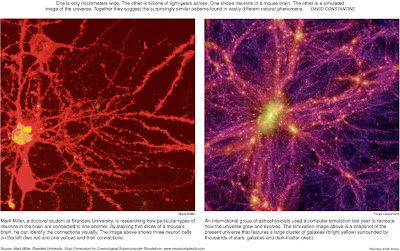
On the left, a cross section of a mouse neuron, stained to show three neurons and their connections. On the right, a snapshot of a simulation of the evolution of the universe at present day. Granted, one is a simulation, the other is a stained representation of biological components, so in reality, it means nothing at all (we aren't living in a the brain of a larger being), but I find the image visually striking and kind of cool to consider philosophically and scientifically. The image on the left is micrometers across. The one on the right is billions of light years across. (One light year is almost ten trillion kilometers.) Click on the link above to see a larger version on the NY Times website.

Tuesday, May 17, 2011

On Cyclic Universes

How old is the universe? Did it have a beginning or is it eternal? There is no more fundamental a question in cosmology than the question of the origins of the universe we see around us, nor one more vexing to theoretical physicists.

The most commonly accepted answer to the above question is the Big Bang model, which states that the universe began, actually started from "nothing," 14 billion years ago. Before this time, the entirety of the universe was shoved into a "point" so small and so dense that the laws of physics, the notion of the dimensionality of space and the flow of time are incomprehensible to us as we understand them today. Why do we think this? Simple. We just rewind what we see happening before us today. Edwin Hubble discovered that the universe was expanding. Not just expanding, but expanding at an accelerating rate. In fact, the further out we look from where we are in the universe today, the faster cosmological structures like galaxies appear to be receding from us. If the universe is expanding, the thinking goes, then at one point in time, everything must have been close together. Using Einstein's theory of general relativity, which explains gravity and it's effect on objects that occupy space-time, theorists can rewind the clock back to the point where it all began. Well, almost to that point. It turns out we can only see back to within 300,000 years of the bang itself. Before this era, the universe was still so energetic and dense that visible light couldn't travel freely about the universe. It wasn't until it began to cool and expand that light began to move from one place to another, transferring information about separated points in space to each other. Before this time, we rely on general relativity to explain what was happening given certain expected energy levels and masses present in the early universe. The equations are reliable and have let us know much about the time before us, but at a certain point, they begin to break down. If you rewind back far enough, well past that 300,000 year limit, the equations begin to break down. The assumption is that this point in time is the beginning and the expansion that followed is all there really is to the universe - a rather unsatisfying conclusion to say the least (even if it may be true). Could there have been more?

Paul Steinhardt at Princeton University certainly thinks there's room for more. In a 2007 article in Seed Magazine, he phrases it this way:
The big bang is formally defined as the moment when the equations say that the temperature and density of the universe became infinite, and it is impossible to extrapolate back any further. Concluding that this represents the beginning of all space and time is suspect, however, as Einstein himself once pointed out. Properly construed, finding that the temperature and density become infinite is an indication that the mathematical equations underlying general relativity have become invalid, not that this is when the universe began.
There are many models for eternal universes out there right now. One of the more interesting ideas put forward by theoretical physicist and mathematician Roger Penrose is a model of a cyclic universe that is eternal and oscillating. The argument goes something like this: the universe has always existed and is eternal and we are living in one of an infinite number of permutations and lives of the universe. The basis for this belief stems back to the days of Einstein, who himself played with the idea of an oscillating universe in the 1930s. He postulated that the universe has existed forever and that each cycle begins with a bang and an outward expansion, followed inevitably by gravity getting a hold of the expansion and slowing it down before reversing it altogether, collapsing the universe back down to a single point for the process to begin again. This is a very simplistic explanation, and there are far more sophisticated explanations for a Big Bounce theory of the universe, but you get the basic idea.

The question is: is there any evidence of such cycles? The light barrier mentioned earlier is certainly an obstacle to seeing back past this point for confirmation of the universe's other lives. It may very well be impossible to know anything for sure about the universe before the big bang, however, Roger Penrose thinks he's found a clue in the cosmic microwave background radiation, the remnant radiation of the earliest times in the universe discovered  in 1964 and which NASA's WMAP space probe has been dutifully mapping. The CMB shows a relatively uniform energy prevalent throughout the observable universe that is a relic of a time when the universe was small and uniform. After expansion and cooling, minor variations in the CMB provided a structure around which galaxies eventually formed. Penrose and colleague Vahe Gurzadyan recently published findings of a series of concentric circular patterns in the CMB that they argue are a sign of pre-Big Bang activity. The circles are areas of small temperature variation between one spot and its neighboring spot in the universe. What could have caused these structures is a mystery, but Penrose has suggested that they are the result of collisions of supermassive black holes causing the creation of uniform spheres of of gravitational waves that radiated outward from the collision and left an imprint on the CMB straight through to the current era.
Ripple Patterns in the WMAP CMB data noticed by Penrose
Other scientists remain skeptical. Earlier last month, physicists Hans Eriksen and Ingunn Wehus conducted a study of the same data examined by Penrose and his colleague and found the exat same evidence of concentric circles. They then built thousands of random simulations of expansion models from the Big Bang to the present and found that the circles showed up in the random models as well. What does this mean? Erikson and Wehus think that it may just be part of the structure of the universe for some reason. No matter how the CMB varies in the models, it still produces the circles. Moreover, they may simply be evidence of processes that occurred in very early times, before the universe expanded and settled and allowed light to travel freely throughout, hiding the evidence of causation. Sounds reasonable enough. I don't have a PhD in math or physics, but it would seem to me that anything that occurred before the Big Bang would in a sense be erased by the condensation of the universe that the cyclic models suggest. Any patterns created by gravitational waves due to colliding supermassive black holes would be erased as the fabric of space were warped back down to a point and a new expansionary phase would create new patterns.

Nevertheless, the idea of a cyclic universe is intriguing, even if we don't have solid evidence of its existence. For one thing, it gets around the sticky point of what caused the Big Bang in the first place if absolutely nothing existed before by simply asserting that everything that currently exists has always existed. Forever. The universe is eternal and we're just in one of its infinite phases. Cyclic theories aren't the only eternal models of the universe, however. It has rivals with names like baby universes and eternal expansion, that are equally intriguing and probably worth covering in future posts.

Monday, May 16, 2011

The limits of knowledge: Things we'll never understand (?)

Michael Brooks has an article over at New Scientist on the limits of knowledge, exploring the world of fundamental questions on the nature of reality that we may never be able to understand (Linkage: The limits of knowledge: Things we'll never understand - space - 09 May 2011 - New Scientist). We live in an age that takes scientific advancement for granted, where computer speeds double every eighteen months and where Hubble publishes breathtaking pictures of rotating galaxies billions of light years away and billions of years in the past. Indeed, we're so immune to the pace of scientific progress that such wonders don't even make the front page any more - they're relegated to the background noise behind the petty political squabbles we fight and Justin Beiber's haircut (appalling, I know). I think the sentiment among the general public is that the discoveries and advancements we make are regularly scheduled; perhaps to the point that no one would even really begin to notice them until they stopped. Is that possible? Will we reach a time where we run up against a gigantic mental roadblock firmly in the way of progress for the first time in humanity's scant existence?

The question isn't as dire as it sounds, and being an optimist, I don't think such limitations should really be taken seriously, but let's explore them for a moment and see what they may have to offer. Brooks's piece begins with a rather thought-provoking and frightening (because I don't think of myself as a chimp) quote from the UK's Astronomer Royal Martin Rees that puts the concern into high relief:
A chimpanzee can't understand quantum mechanics. It's not that a chimpanzee is struggling to understand quantum mechanics. It's not even aware of it. There is no reason to believe that our brains are matched to understanding every level of reality.
At first glance this sounds completely reasonable, and it is. There is no real way of being one hundred percent certain that we are even missing some fundamental aspect of our reality from our scientific framework. In fact, we may never really have the problem of running up against a "knowledge wall" at all. We may one day believe that we've found a complete Theory of Everything, verified time and again by experiment and still be missing some piece of the puzzle that we're not even aware exists. If we were to magically create the technology necessary to completely and thoroughly explore our universe and map it in complete detail, we'd never be able to be one hundred percent certain that there is or is not something beyond what we see, curled up in another dimension or nestled in a floating brane a hair's breadth from the one in which our universe is currently residing. In that respect, science could truly be endless, like a stack of matryoshka dolls continuing ad infinitum. Of course this lends itself to tons of absurdities. By the same logic I can argue that an army of invisible and subatomically small Wookies are responsible for gravity because you can't disprove it. So where do we draw the line? What makes something reasonable and something else not? Theoretical physics is pushing the envelope of the believable every single day, offering up explanations for the behavior of everyday objects that thoroughly stretch, if not completely defy, the imagination. (Just flip through the Wikipedia page for M-Theory to get a taste of multidimensional superstring theory to see what I'm talking about).
Indeed it does.

So what do we do about this dilemma? What science should we trust and what science do we hold suspect? How do we ever know if we have reached a true, complete theory of reality or if we need to keep looking? The first step is recognizing the limits you're working with. Einstein recognized this very early on and I don't think I can really improve upon his metaphor:
Physical concepts are free creations of the human mind, and are not, however it may seem, uniquely determined by the external world. In our endeavor to understand reality, we are somewhat like a man trying to understand the mechanism of a closed watch. He sees the face and the moving hands, even hears its ticking , but he has no way of opening the case. If he is ingenious he may form some picture of a mechanism which could be responsible for all the things he observes, but he may never be quite sure his picture is the only one which could explain his observations. He will never be able to compare his picture with the real mechanism and he cannot even imagine the possibility of the meaning of such a comparison. 
Sounds pretty much the same as Rees - but the clock analogy here is much more powerful. Any number of explanations for how the watch works can be "correct" if they make testable predictions about the watch's behavior and if they mesh well with other things we observe to be true about our universe. But which is really, really correct? The honest answer: it doesn't matter. They all are. Scientific theories are simply models and approximations, nothing more. We are simultaneously a part of reality and divorced from it in a mentally abstract way. These models are correct so long as they are useful to us in explaining the world around us in a coherent way. My Wookie gravity theory could be correct, but, sadly, offers no basis for experimental confirmation or utility in explaining anything else around me. In that respect, even if at the fundamental level it were true, it's useless and therefore not worthy of my further pursuit. Don't get me wrong, it's really fun to daydream, and not everything in life has to serve some purpose or be branded useless, but this method of thinking does offer us a system through which we can advance and sort through the overwhelming number and variety of scientific theories out there today.

Brooks divides his problems into three categories, providing examples of each to highlight the limiting problems we face in fields from biology to physics and astronomy. Brooks:
There are some things we can never know for sure because of the fundamental constraints of the physical world. Then there are the problems that we will probably never solve because of the way our brains work. And there may be equivalents to Ree's observation about chimps and quantum mechanics - concepts that will forever lie beyond our ken.
Brooks himself is quick to point out that we often times can make tremendous progress once we know something about what we "can't" know, like with Heisenberg's Uncertainty Principle. The optimist in me would like to argue against all three of his points. Firstly, the history of scientific progress has been a creative one. By the end of the nineteenth century, many in the science profession advised young undergraduates against going into the field of physics because everything worth knowing had already been found. Luckily for us, Einstein ignored such presumption and provided a paradigm shift that has endured for well on a hundred years. What it will take for more progress once a similar 21st century wall is reached may be similar creative thinking. Fundamentally different ways of thinking that cast reality in a new light, which promising new ideas like the Holographic Principle may potentially do. Perhaps we've learned all we can on this "level." What we should be seeking is a deeper one from which the things we observe that give us problems emerge so we can place them in context. As for how our brains work, humans have proven ingenious at solving problems in the short time we've been around. Where our own brains have fallen short we've supplemented them with printed libraries, the salons of the Enlightenment, computers and calculators and the group thinking of the internet. As a (more or less) cooperative species, I don't take such biological limitations seriously. For the last, we return to Einstein's watch. Embracing a little subjective reality, if a concept is "forever beyond our ken," it hardly seems worth worrying about as it becomes something that transcends our experience of reality. I don't want to get into metaphysics here, but from a scientific perspective, if these concepts can't be understood using the logic we're capable of, then we'll remain as blissfully unaware of them as we are of the army of Wookies holding your feet to the ground and keeping the sun a nice, neat, contained (and useful) nuclear explosion for us.

Sunday, May 8, 2011

Death from the Skies

Death from the Skies!: These Are the Ways the World Will End . . .Death from the Skies!: These Are the Ways the World Will End . . . by Philip C. Plait

My rating: 5 of 5 stars


If you aren't reading Phil Plait's Bad Astronomy blog over at Discover magazine, you should be. His writing is an awesome example of how real science can be just as awe-inspiring, cool and interesting as the "science" that underlays our most exciting and captivating science fiction stories.


Are you a fan of disaster movies? Then, Death from the Skies is for you. In this short volume, Plait uncovers the real science behind a host of truly dreadful end of the world scenarios from asteroid impacts to the eventual, but certain, heat death of the universe, putting each in cosmic perspective in terms of the scope of the catastrophe and its likelihood of occurrence. What makes this exploration so much fun is Plait's own enthusiasm for the subject. He manages to strike a delicate balance between his appreciation for the creativity of science fiction and the scientific rigors of his profession (Plait is a PhD in Astronomy and a well known skeptic and debunker of all things astronomically ridiculous) which prevents Death from the Skies from becoming either too sensationalist or statistically boring and mundane. The result: we have very, very little to personally fear from any of the disasters outlined in the book. The genius is that while Plait puts the odds in context (some of which are so small they really may as well be zero), he still writes in such a way that makes the discussion of the forces and power involved in these events exciting and fascinating.


Each chapter opens with a creative vignette that gives a human perspective to the discussion of the disaster to follow, which gets your survival instincts and adrenaline thrumming. Plait paints a realistic scenario for the playing out of the event and its impact on human life, giving in a bit to theater, but in an enjoyable way that manages to peak your interest for the scientific discussion to follow. The sheer magnitude of these disasters defies the imagination and Plait does an admirable job of providing some jaw-dropping statistics in ways that don't make your eyes glaze over - mostly because he puts them in every day context by providing some appropriate analogies that still leave you gazing at the wall for a good couple minutes as you try and wrap your mind around it.


The overall feeling you get after reading Death from the Skies is one of absolute wonder. The universe is an incredibly hostile place for beings as sensitive and delicate as we are and Plait paints a devastatingly realistic picture of how tenuous life's grasp on Earth really is, but he balances it well by pointing out that if the universe weren't so, we probably wouldn't be here anyway. A well-known saying in astronomy is that we were literally born from the death of stars, which forged the heavier elements that come together to form life, and Plait makes active use of this reference throughout his work, extending the description to form an interconnected web that creates a multibillion year cycle of creation and destruction that happened precisely to create and maintain life on our little planet. He also does a magnificent job of putting time into perspective, noting that though our history may seem "long" to us, it is a literally insignificant drop in the bucket compared to the life of the Earth itself, which is also just a drop in the galactic bucket, which is in turn....you get what I mean. Plait also manages to hold on, in spite of such vast proportions and epic time scales, to the human perspective, relating everything back to us; what a supernova half the galaxy away means to us, what the supermassive black hole lurking at the heart of our galaxy means to us and so on.


Death from the Skies is a fun read that will put the universe and our place in it in perspective, while at the same time teaching you rock solid astronomy and physics, probably without you being even aware of it.


View all my reviews